
American Whiskey – History, Ingredients, Production, Types, Regions & Famous Brands
1. The History of American Whiskey
Early Colonial Era (1600s – 1700s)
European settlers, especially Scots-Irish immigrants, brought distilling traditions to America. They adapted their recipes using available grains like corn, rye, wheat, and barley.
18th Century (Birth of Bourbon & Rye)
Corn became the main grain in Kentucky, while rye dominated in Pennsylvania and Maryland. Whiskey became popular as both a currency and a daily staple.
The Whiskey Rebellion (1791–1794)
Farmers protested against federal excise taxes on whiskey, showing how important whiskey was to American society and economy.
19th Century (Rise of Bourbon)
Kentucky emerged as the heart of Bourbon. The sour mash process was introduced, improving consistency. Tennessee developed its own “Lincoln County Process” with charcoal filtering.
Prohibition (1920–1933)
Legal distilling was banned, but whiskey was still produced illegally (moonshine) or sold for “medicinal purposes.” After repeal, major distilleries rebounded, shaping today’s whiskey industry.
Modern Era
Today, American whiskey includes Bourbon, Tennessee whiskey, Rye, Wheat whiskey, and Craft/small-batch whiskies. It is legally protected with specific production standards.
—
2. Ingredients of American Whiskey
Grains (Mash Bill)
Corn (sweet, rich body)
Rye (spicy, peppery notes)
Wheat (soft, smooth, mellow character)
Barley (enzymes for fermentation, nutty flavors)
Water
Limestone-filtered water in Kentucky and Tennessee removes iron and adds minerals.
Yeast
Strains passed down through generations provide unique house flavors.
—
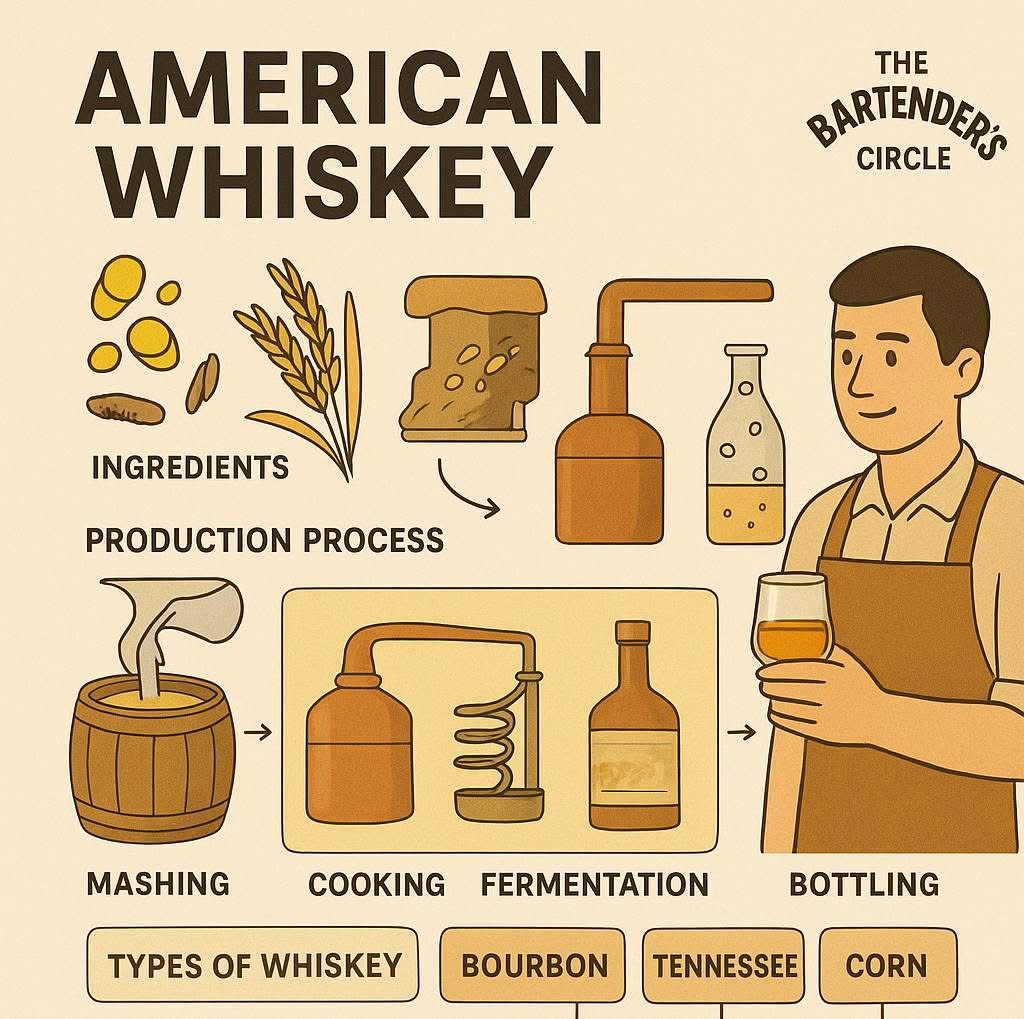
3. Production Process (Step by Step)
1. Mashing – Grains are ground, mixed with hot water to release starches.
2. Cooking – Enzymes break down starch into fermentable sugars.
3. Fermentation – Yeast is added; sugars convert to alcohol (beer-like mash).
4. Distillation – The mash is distilled (usually in column stills or pot stills) to concentrate alcohol and flavors.
5. Lincoln County Process (Tennessee only) – Whiskey is filtered through sugar maple charcoal before aging.
6. Aging – Whiskey is matured in new, charred American oak barrels (minimum 2 years for Straight Whiskey).
7. Bottling – Whiskey is filtered, proofed (with water), and bottled.
—
4. Types of American Whiskey
Bourbon – At least 51% corn, aged in new charred oak.
Tennessee Whiskey – Bourbon rules + charcoal filtering (Lincoln County Process).
Rye Whiskey – At least 51% rye, spicy and robust.
Wheat Whiskey – At least 51% wheat, soft and mellow.
Corn Whiskey – At least 80% corn, often unaged or lightly aged.
American Single Malt – 100% malted barley, newer category.
Blended American Whiskey – Mix of straight whiskey and neutral spirits.
—
5. Major Whiskey Producing Regions in the U.S.
1. Kentucky – Birthplace of Bourbon, limestone water, humid summers.
Famous for Bourbon (Maker’s Mark, Woodford Reserve).
2. Tennessee – Known for Tennessee whiskey.
Famous for Jack Daniel’s, George Dickel.
3. Indiana – Large-scale rye production (MGP distillery supplies many brands).
4. Pennsylvania & Maryland – Historical home of Rye whiskey.
5. Craft Whiskey Regions – Colorado, Texas, New York, and California producing modern craft whiskies.
—
6. Famous American Whiskey Types & Brands (with Ingredients)
A. Bourbon
Characteristics: Sweet, rich, vanilla, caramel notes.
Famous Brands (5 examples with mash bills):
1. Maker’s Mark – 70% Corn, 16% Red Winter Wheat, 14% Malted Barley.
2. Woodford Reserve – 72% Corn, 18% Rye, 10% Malted Barley.
3. Buffalo Trace – 75% Corn, 21% Rye, 4% Malted Barley.
4. Wild Turkey – 75% Corn, 13% Rye, 12% Malted Barley.
5. Jim Beam – 75% Corn, 13% Rye, 12% Malted Barley.
—
B. Tennessee Whiskey
Characteristics: Smooth, mellow, charcoal-filtered.
Famous Brands (5 examples with mash bills):
1. Jack Daniel’s Old No. 7 – 80% Corn, 12% Rye, 8% Malted Barley.
2. George Dickel No. 12 – 84% Corn, 8% Rye, 8% Malted Barley.
3. Uncle Nearest 1856 – 84% Corn, 8% Rye, 8% Malted Barley.
4. Collier & McKeel – 70% Corn, 15% Rye, 15% Malted Barley.
5. Nelson’s Green Brier – Mash bill undisclosed, corn-heavy bourbon-style.
—
C. Rye Whiskey
Characteristics: Spicy, dry, peppery notes.
Famous Brands (5 examples with mash bills):
1. Bulleit Rye – 95% Rye, 5% Malted Barley.
2. Sazerac Rye – 51% Rye, 39% Corn, 10% Malted Barley.
3. WhistlePig 10 Year – 100% Rye.
4. Old Overholt – 70% Rye, 15% Corn, 15% Malted Barley.
5. High West Double Rye! – Blend of 95% Rye & 5% Malted Barley with younger rye.
—
D. Wheat Whiskey
Characteristics: Gentle, smooth, sweet bread-like notes.
Famous Brands (5 examples with mash bills):
1. Bernheim Original – 51% Wheat, 39% Corn, 10% Malted Barley.
2. Rebel Yell Wheated Bourbon – 68% Corn, 20% Wheat, 12% Malted Barley.
3. Larceny Bourbon – 68% Corn, 20% Wheat, 12% Malted Barley.
4. Weller Special Reserve – 70% Corn, 16% Wheat, 14% Malted Barley.
5. Parker’s Heritage Wheat Whiskey – 52% Wheat, 36% Corn, 12% Malted Barley.
—
E. Corn Whiskey
Characteristics: High corn sweetness, often unaged.
Famous Brands (5 examples with mash bills):
1. Mellow Corn – 90% Corn, 10% Malted Barley.
2. Balcones Baby Blue – 100% Blue Corn.
3. Heaven Hill Corn Whiskey – 80% Corn, 8% Rye, 12% Malted Barley.
4. Georgia Moon Corn Whiskey – 81% Corn, remainder Rye & Barley.
5. Platte Valley Corn Whiskey – 80% Corn, 20% Malted Barley.
#highlightseveryone #knowledge #whisky #mixology #bartender